Safety & Workshop
Dust Extraction
Capture silica at the source — the only control that really works.
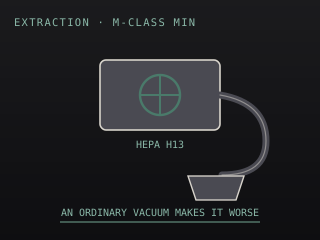
Specifications
| Filtration | HEPA H13 / M-class, 99.95 % at 0.3 µm |
|---|---|
| Airflow | Minimum 200 m³/h at the hood |
| Hood type | Capture hood at the cutting point, or downdraft table |
| Extraction class | M-class minimum for silica; H-class preferred |
| Wet separation | Water trap reduces filter loading |
| Noise | Below 70 dB(A) for continuous use |
| Best for | Every dry cutting, grinding and sanding operation |
Technical parameters
| Material | HEPA-filtered unit, flexible hose, capture hood |
|---|---|
| Protects against | Airborne crystalline silica and stone dust |
| Standard | M-class (EN 60335-2-69) minimum for silica |
| Pairs with | Respirator, wet methods, ventilation |
| Maintenance | Empty and clean on schedule; check filter seals |
| Never | Use an ordinary workshop vacuum — it exhausts fine dust back into the air |
SafetySelect Rough Out Refine FinishDUST HIGH
Overview
Respirators protect the operator. Extraction protects the whole studio, including everyone who walks through it later. Silica dust settles on every surface and becomes airborne again the next time the room is disturbed. Capturing it at the tool, with a HEPA-class extractor and a wet-clean regime, is the only control that addresses the problem at the source.
Using it
- Position the hood as close to the cutting point as you can without obstructing the tool. Distance kills capture efficiency.
- Combine extraction with wet methods wherever the stone allows. Together they remove most of the airborne dust.
- Never dry-sweep a stone studio. Wipe with wet cloths or use a wet vacuum.
- Change filters on schedule, not when airflow becomes obviously poor.
Safety notes
- An ordinary vacuum cleaner with a cloth bag makes silica exposure worse, not better. It filters poorly and exhausts the fines.
- Emptying an extractor releases a concentrated dust cloud. Do it outdoors, wearing a mask.
- Extraction does not replace a respirator. Use both.
Works with
Educational reference only. Figures marked typical are conventional workshop ranges, not manufacturer specifications. This site sells nothing and endorses no brand. Working stone produces respirable crystalline silica — control the dust at the source, and check your local regulations, which may be stricter than the general practice described here.
Related safety
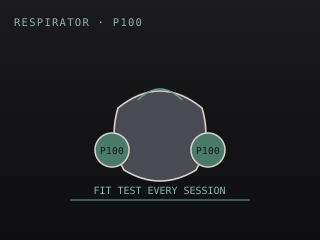
Respirator
The single most important piece of equipment in a stone studio.
SafetySelect · Rough Out · Refine · Finish
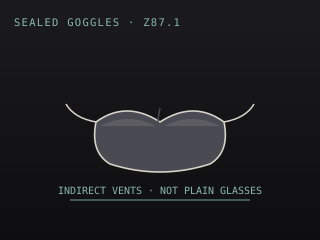
Safety Glasses
Sealed goggles, not fashion glasses, for impact and dust.
SafetySelect · Rough Out · Refine · Finish
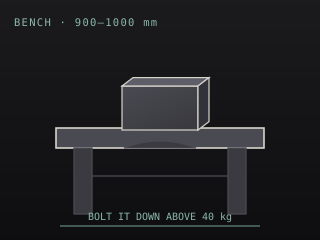
Workbench
A heavy bench that absorbs the blow instead of bouncing it back.
SafetySelect · Rough Out · Refine · Finish · Seal