Safety & Workshop
Respirator
The single most important piece of equipment in a stone studio.
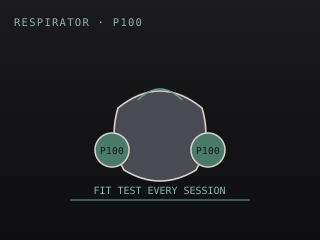
Specifications
| Type | Half-mask elastomeric, or N95/P95 disposable |
|---|---|
| Filter class | P100 / P3 for silica; P95 minimum |
| Fit test | Required — a leaking mask offers no protection |
| Cartridge life | 40 h of use or when breathing resistance rises |
| Faceseal | Silicone, sized S/M/L |
| Storage | Sealed bag, away from solvents |
| Best for | Every dry cutting, grinding and carving operation |
Technical parameters
| Material | Silicone or TPE faceseal, replaceable filters |
|---|---|
| Protects against | Respirable crystalline silica, gypsum, talc dust |
| Standard | P100 (US) / P3 (EN) for silica-bearing dust |
| Pairs with | Dust extraction, wet methods, ventilation |
| Maintenance | Replace filters on schedule, clean the mask weekly |
| Never | Use a dust mask for solvent vapour — wrong filter entirely |
SafetySelect Rough Out Refine FinishDUST LOW
Overview
Crystalline silica is the hazard that defines stone carving as an occupational risk. Respirable particles are far too small to see and stay airborne for hours. The damage is cumulative and irreversible, and it does not announce itself until it is advanced. A half-mask with P100 filters is the working minimum for any dry stone operation.
Using it
- A P100 half-mask is the sensible default for stone. Disposable P95 masks are a fallback, not a plan.
- Do a fit check every time: cover the filters and breathe in. The mask should collapse slightly and hold.
- Filters are consumable. Replace on schedule rather than waiting for a smell or a taste.
- Store the mask sealed. A mask left on a dusty bench is a dusty mask.
Safety notes
- Fit is everything. A mask that leaks at the nose delivers almost no protection, however good the filter.
- Beards and stubble break the faceseal. This is a fit problem, not a comfort problem.
- A mask is the last line of defence, not the first. Extract at the source and wet the work where you can.
Works with
Granite blockSandstone blockBush hammerDust extractionPneumatic hammer
Educational reference only. Figures marked typical are conventional workshop ranges, not manufacturer specifications. This site sells nothing and endorses no brand. Working stone produces respirable crystalline silica — control the dust at the source, and check your local regulations, which may be stricter than the general practice described here.
Related safety
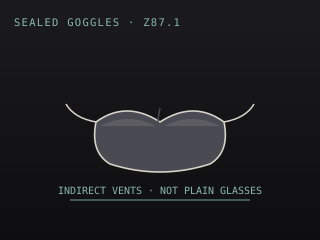
Safety Glasses
Sealed goggles, not fashion glasses, for impact and dust.
SafetySelect · Rough Out · Refine · Finish
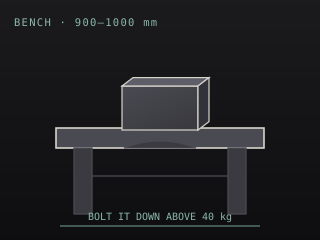
Workbench
A heavy bench that absorbs the blow instead of bouncing it back.
SafetySelect · Rough Out · Refine · Finish · Seal
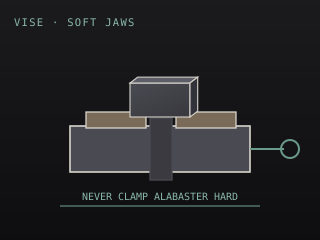
Stone Vise
Holds the block so both your hands are free to work it.
SafetyRefine · Finish