Safety & Workshop
Workbench
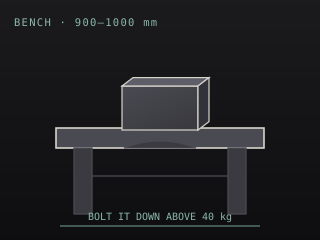
A heavy bench that absorbs the blow instead of bouncing it back.
Specifications
| Top thickness | 50 – 100 mm solid timber |
|---|---|
| Height | 900 – 1000 mm, matched to your elbow |
| Working area | Minimum 1200 × 600 mm |
| Load capacity | 500 kg or more for large blocks |
| Damping | Sandbag or sand bed under the work |
| Legs | Braced, splayed or bolted to the floor |
| Best for | Every carving operation |
Technical parameters
| Material | Solid hardwood or laminated timber top, steel or timber frame |
|---|---|
| Stone suitability | All stone types |
| Stage | All stages |
| Pairs with | Stone vise, sandbag, dust extraction |
| Maintenance | Re-tighten bracing; replace a split top |
| Never | Work a large block on a bench that is not bolted down |
SafetySelect Rough Out Refine Finish Seal
Overview
Stone is heavy and the blows are hard, so a bench has one job above all: absorb energy without moving. A light bench rattles, bounces the blow back into the chisel, and walks across the floor. The usual solution is a bench built from thick timber with a sandbag or a bed of sand beneath the stone to damp the shock.
Using it
- Set the bench height so your forearm is horizontal when the chisel is at working height.
- Bed the stone on a sandbag. It absorbs shock, holds the block still, and reduces the noise dramatically.
- Bolt the bench to the floor if you work anything over about 40 kg.
- Keep the working area clear of tools you are not using — a chisel on the floor under a heavy block is a bad combination.
Safety notes
- Bench height decides your posture for years. Too low and you will hunch into a chronic back injury.
- A block that shifts mid-blow sends the chisel somewhere unintended. Damping and secure footing are safety equipment.
- Do not overhang a heavy block. A tipping bench drops the stone on your feet.
Works with
Educational reference only. Figures marked typical are conventional workshop ranges, not manufacturer specifications. This site sells nothing and endorses no brand. Working stone produces respirable crystalline silica — control the dust at the source, and check your local regulations, which may be stricter than the general practice described here.
Related safety
Respirator
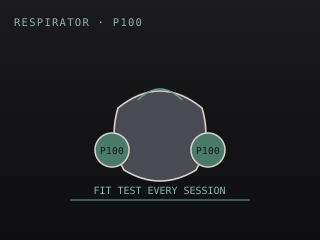
The single most important piece of equipment in a stone studio.
SafetySelect · Rough Out · Refine · Finish
Safety Glasses
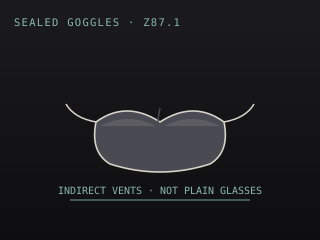
Sealed goggles, not fashion glasses, for impact and dust.
SafetySelect · Rough Out · Refine · Finish
Stone Vise
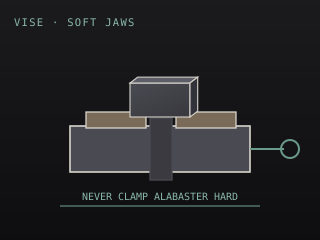
Holds the block so both your hands are free to work it.
SafetyRefine · Finish