Finishing & Polishing
Carborundum Stone
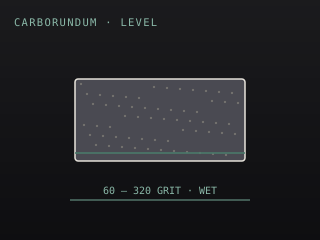
A bonded silicon-carbide block for leveling and cutting back.
Specifications
| Size | 100 × 50 × 25 mm to 200 × 50 × 50 mm |
|---|---|
| Grit | Coarse (60) to fine (320) |
| Material | Bonded silicon carbide |
| Bond | Vitrified or resin |
| Shape | Rectangular block, some with a bevelled edge |
| Use | Wet or dry — wet cuts faster and lasts longer |
| Best for | Leveling, removing chisel marks, shaping |
Technical parameters
| Material | Bonded silicon carbide abrasive |
|---|---|
| Stone suitability | Marble, limestone, alabaster, soapstone |
| Stage | Finish — between chisel work and paper |
| Pairs with | Sandpaper, polishing pad, water |
| Maintenance | Flatten on a flat plate; keep it wet |
| Never | Use a single stone for both coarse and fine work |
FinishingFinish
Overview
A block of bonded silicon carbide grit, used like a flexible grinding stone to level a surface, remove chisel marks, or shape the softer stones. It cuts fast and leaves a uniformly scratched surface that the abrasive papers then refine. Because it is a solid block, it levels rather than follows — which is exactly what a wavy surface needs.
Using it
- Keep it flooded with water. A dry carborundum stone glazes and stops cutting.
- Work in a figure-eight or circular pattern to avoid developing a low spot.
- It levels, so use it deliberately where the surface is uneven and lightly where it is not.
- Move to abrasive paper once the surface is uniformly flat, not before.
Safety notes
- Wet use is strongly preferred — it controls dust and keeps the stone cutting. Do not let it dry out mid-work.
- Silica-bearing slurry is still a hazard. Do not let it dry on surfaces where it can become airborne again.
- Do not use a cracked stone. It will break under load.
Works with
Marble blockLimestone blockSandpaperPolishing padWater
Educational reference only. Figures marked typical are conventional workshop ranges, not manufacturer specifications. This site sells nothing and endorses no brand. Working stone produces respirable crystalline silica — control the dust at the source, and check your local regulations, which may be stricter than the general practice described here.