Finishing & Polishing
Riffler File
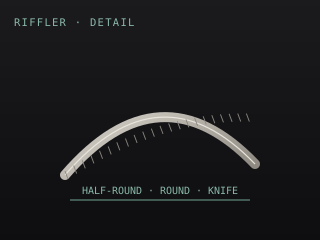
Small curved files that reach into detail no chisel can follow.
Specifications
| Length | 150 – 200 mm overall, 60 – 80 mm cutting |
|---|---|
| Shapes | Half-round, round, knife, oval, crossing |
| Cut | 0 (coarse) to 4 (fine), or diamond coated |
| Material | Hardened steel, or diamond-plated on steel |
| Cutting end | Double-ended, two different profiles |
| Handle | None — held between finger and thumb |
| Best for | Detail refinement, softer stone, cleanup |
Technical parameters
| Material | Hardened steel or diamond-plated steel |
|---|---|
| Stone suitability | Alabaster, soapstone, marble, limestone |
| Stage | Refine and detail |
| Pairs with | Carborundum stone, sandpaper, rasp |
| Maintenance | Brush the teeth; diamond rifflers last far longer |
| Never | Force a steel riffler on granite — it will be destroyed |
FinishingRefine
Overview
Short, double-ended files bent into a range of curves, so the cutting surface can be worked inside a concavity or around a detail. Rifflers are how the transition between two forms gets smoothed, and they are the primary shaping tool for the softer stones — alabaster and soapstone are worked almost entirely with files and rasps.
Using it
- Use a drawing motion, lifting on the return stroke — files cut in one direction.
- Match the profile to the curve. A round riffler in a flat-bottomed groove will only scratch.
- Card the file every few minutes. Clogged teeth skate and scratch.
- For alabaster and soapstone, a coarse rasp followed by finer rifflers replaces most chisel work entirely.
Safety notes
- File teeth are sharp and the tool is short. A slip puts the cutting surface into your hand.
- Stone dust from hand filing is fine and stays airborne. A mask and extraction still apply.
- Steel files wear out silently. A dull file burnishes instead of cutting and can crack soft stone.
Works with
Alabaster blockSoapstone blockMarble blockSandpaperPolishing pad
Educational reference only. Figures marked typical are conventional workshop ranges, not manufacturer specifications. This site sells nothing and endorses no brand. Working stone produces respirable crystalline silica — control the dust at the source, and check your local regulations, which may be stricter than the general practice described here.