Stone & Materials
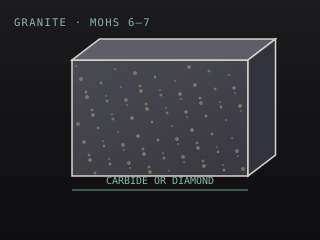
Granite Block
Hard, abrasive igneous stone that resists steel entirely.
Specifications
| Typical block sizes | 20 × 20 × 20 cm to 50 × 50 × 100 cm |
|---|---|
| Density | 2.6 – 2.9 g/cm³ (≈ 2.75) |
| Mohs hardness | 6 – 7 (quartz at 7) |
| Grain | Interlocking, no cleavage planes |
| Porosity | Very low, < 1 % |
| Colour range | Grey, pink, black, speckled |
| Sound stone sounds | A tight, high click |
Technical parameters
| Material | Igneous — quartz, feldspar, mica |
|---|---|
| Working hardness | Mohs 6 – 7, resists hardened steel |
| Chisel type | Tungsten carbide tipped, or diamond abrasive |
| Best for | Outdoor work, plinths, hard-wearing surfaces |
| Avoid | Hand-tool roughing unless you have the patience of a saint |
| Cost band | Medium — setts and offcuts are widely available |
StoneSelect Rough Out Refine FinishMOHS: 6.5DUST HIGHSTABLE
Overview
An igneous rock of interlocking quartz and feldspar with no natural planes of weakness. That is precisely the problem: there is no grain to exploit, so every removal is a fight. Hardened steel will not hold an edge in granite — tungsten carbide or diamond is mandatory, and the silica content makes the dust far more hazardous than marble dust.
Using it
- Do not attempt granite with fire-sharp carbon steel. The edge will be gone within minutes.
- Work with diamond abrasives rather than impact tools wherever you can.
- Cool the cut continuously — heat dulls carbide faster than abrasion does.
- Because there is no grain, you can approach the form from any direction. Use that.
Safety notes
- Granite dust carries the highest crystalline silica fraction of the common stones. Never dry-cut without P100 respiratory protection.
- Silica exposure risk is cumulative and permanent. Assume every dry cut is a dose.
- Carbide fragments spall off blunt tips and travel. Eye protection without exception.
Works with
Point chiselBush hammerPneumatic hammerCarborundum stoneDust extraction
Educational reference only. Figures marked typical are conventional workshop ranges, not manufacturer specifications. This site sells nothing and endorses no brand. Working stone produces respirable crystalline silica — control the dust at the source, and check your local regulations, which may be stricter than the general practice described here.
Related stone
Marble Block
Dense, translucent calcite stone — the classic sculptural material.
StoneSelect · Rough Out · Refine · Finish · Seal
Limestone Block
Soft, forgiving sedimentary stone — the sensible first block.
StoneSelect · Rough Out · Refine · Finish · Seal
Sandstone Block
Layered quartz sand — cheap, plentiful, and directionally fragile.
StoneSelect · Rough Out · Refine · Finish