Stone & Materials
Sandstone Block
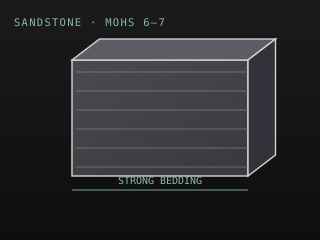
Layered quartz sand — cheap, plentiful, and directionally fragile.
Specifications
| Typical block sizes | 20 × 20 × 30 cm to 50 × 50 × 100 cm |
|---|---|
| Density | 2.2 – 2.6 g/cm³ (≈ 2.3) |
| Mohs hardness | 6 – 7 (quartz grains in a softer matrix) |
| Grain | Strong bedding planes, visible stratification |
| Porosity | Moderate to high, 5 – 25 % |
| Colour range | Buff, red, grey, brown |
| Sound stone sounds | A flat, slightly hollow tap |
Technical parameters
| Material | Sedimentary — cemented quartz grains |
|---|---|
| Working hardness | Variable; soft matrix, hard grains |
| Chisel type | Steel for bulk, carbide for stubborn beds |
| Best for | Architectural work, texture, outdoor pieces |
| Avoid | Fine unsupported detail cut across the bed |
| Cost band | Low — the most affordable of the common stones |
StoneSelect Rough Out Refine FinishMOHS: 6DUST HIGHGRAIN RISK
Overview
Cemented quartz grains with a strong bedding direction. It carves at a reasonable rate and takes fine detail, but it is anisotropic in the extreme: work it against the bed and it delaminates in sheets. Widely available and inexpensive, which makes it good for practice, and it holds up outdoors far better than limestone.
Using it
- Establish the bed direction on day one and mark it on the block. Everything else follows from that.
- Rough out across the bed with a point chisel, then work down.
- Do not undercut across the bedding — that is how a piece becomes a pile.
- It takes texture beautifully. A bush hammer finish suits it better than a polish.
Safety notes
- Sandstone is quartz. Its dust is close to pure crystalline silica and is among the most hazardous in the workshop.
- Never dry-cut sandstone indoors, even briefly, even with the window open.
- Delamination can release a slab edge without warning. Stand clear of the bed direction while roughing.
Works with
Educational reference only. Figures marked typical are conventional workshop ranges, not manufacturer specifications. This site sells nothing and endorses no brand. Working stone produces respirable crystalline silica — control the dust at the source, and check your local regulations, which may be stricter than the general practice described here.
Related stone
Marble Block
Dense, translucent calcite stone — the classic sculptural material.
StoneSelect · Rough Out · Refine · Finish · Seal
Granite Block
Hard, abrasive igneous stone that resists steel entirely.
StoneSelect · Rough Out · Refine · Finish
Limestone Block
Soft, forgiving sedimentary stone — the sensible first block.
StoneSelect · Rough Out · Refine · Finish · Seal