Stone & Materials
Marble Block
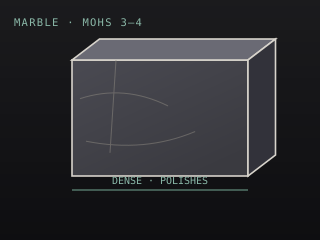
Dense, translucent calcite stone — the classic sculptural material.
Specifications
| Typical block sizes | 30 × 30 × 60 cm to 60 × 60 × 150 cm |
|---|---|
| Density | 2.6 – 2.8 g/cm³ (≈ 2.7) |
| Mohs hardness | 3 – 4 |
| Grain | Uniform, saccharoidal; calcite cleavage in 3 directions |
| Porosity | Low, 0.2 – 2 % |
| Colour range | White, grey, cream, green, black, veined |
| Sound stone sounds | A clear ring under a knuckle tap |
Technical parameters
| Material | Metamorphic calcite / dolomite |
|---|---|
| Working hardness | Mohs 3 – 4, cuts with hardened steel |
| Chisel type | Fire-sharp steel; carbide for prolonged work |
| Best for | Figure, portrait, drapery, polished work |
| Avoid | Outdoor freeze-thaw cycles without a plinth |
| Cost band | Medium — quarry offcuts are cheapest |
StoneSelect Rough Out Refine Finish SealMOHS: 3.5DUST MEDIUMGRAIN RISK
Overview
A metamorphic limestone that recrystallised under heat and pressure into interlocking calcite grains. That interlock is why marble takes a crisp edge and a deep polish, and also why a single hidden vein can split a finished figure. Carrara-class whites are the reference point; coloured and veined marbles behave identically at the chisel.
Using it
- Sound the block with a knuckle before buying. A dull thud means an internal fissure.
- Rough out along the grain with a point chisel at about 30° to the surface.
- Marble bruises: a heavy blow in one spot can cloud the stone several centimetres deep.
- Wet the block to reveal the true colour and any veining before you commit to a design.
Safety notes
- Dry cutting marble produces respirable crystalline silica. Cut wet or use P100 filtration with local extraction.
- A 60 × 60 × 60 cm marble block is roughly 580 kg. Never move one by hand or by pinch bar alone.
- Marble dust is alkaline; prolonged skin contact dries and cracks the hands. Gloves and a barrier cream.
Works with
Flat chiselPoint chiselTooth chiselRiffler filePolishing pad
Educational reference only. Figures marked typical are conventional workshop ranges, not manufacturer specifications. This site sells nothing and endorses no brand. Working stone produces respirable crystalline silica — control the dust at the source, and check your local regulations, which may be stricter than the general practice described here.
Related stone
Granite Block
Hard, abrasive igneous stone that resists steel entirely.
StoneSelect · Rough Out · Refine · Finish
Limestone Block
Soft, forgiving sedimentary stone — the sensible first block.
StoneSelect · Rough Out · Refine · Finish · Seal
Sandstone Block
Layered quartz sand — cheap, plentiful, and directionally fragile.
StoneSelect · Rough Out · Refine · Finish