Stone & Materials
Limestone Block
Soft, forgiving sedimentary stone — the sensible first block.
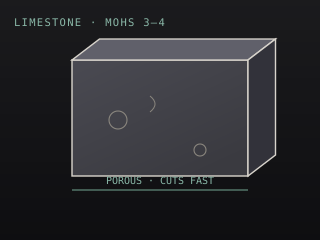
Specifications
| Typical block sizes | 20 × 20 × 40 cm to 60 × 40 × 120 cm |
|---|---|
| Density | 2.2 – 2.6 g/cm³ (≈ 2.4) |
| Mohs hardness | 3 – 4 (softer and more variable than marble) |
| Grain | Bedding planes; carves cleanly across the bed |
| Porosity | High, 5 – 20 % |
| Colour range | Cream, buff, grey, pale blue |
| Sound stone sounds | A soft, even tap |
Technical parameters
| Material | Sedimentary calcium carbonate |
|---|---|
| Working hardness | Mohs 3 – 4, cuts freely with steel |
| Chisel type | Fire-sharp steel throughout |
| Best for | Beginners, architectural detail, large work |
| Avoid | Frost-exposed exterior siting without sealing |
| Cost band | Low — often the cheapest block per cubic metre |
StoneSelect Rough Out Refine Finish SealMOHS: 3.5DUST MEDIUMSTABLE
Overview
A sedimentary rock of calcium carbonate, usually with visible fossil content and open pores. It is soft enough to shape with ordinary steel at a good rate, it does not bruise the way marble does, and it has comparatively few fissures. The trade-off is porosity: it drinks water and stains, so outdoor siting needs thought.
Using it
- Bedding planes are usually visible. Rough out across the bed, not along it.
- A large dummy mallet gives better control here than a heavy stone hammer.
- Because it is porous, seal limestone before exterior display.
- It is the best stone for learning lettering — it cuts predictably and takes a clean arris.
Safety notes
- Limestone dust still contains crystalline silica, though at a lower fraction than granite. Wet work is the simplest control.
- Porous blocks absorb water and become significantly heavier. Account for that when lifting.
- Fossil inclusions can be harder than the surrounding stone and deflect a chisel without warning.
Works with
Educational reference only. Figures marked typical are conventional workshop ranges, not manufacturer specifications. This site sells nothing and endorses no brand. Working stone produces respirable crystalline silica — control the dust at the source, and check your local regulations, which may be stricter than the general practice described here.
Related stone
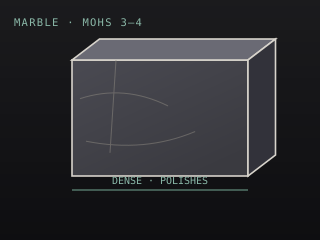
Marble Block
Dense, translucent calcite stone — the classic sculptural material.
StoneSelect · Rough Out · Refine · Finish · Seal
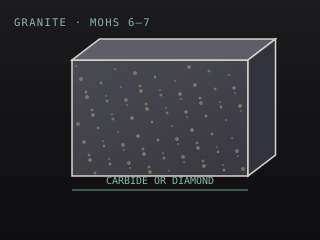
Granite Block
Hard, abrasive igneous stone that resists steel entirely.
StoneSelect · Rough Out · Refine · Finish
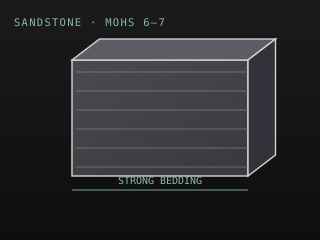
Sandstone Block
Layered quartz sand — cheap, plentiful, and directionally fragile.
StoneSelect · Rough Out · Refine · Finish