Chisels & Carving
Point Chisel
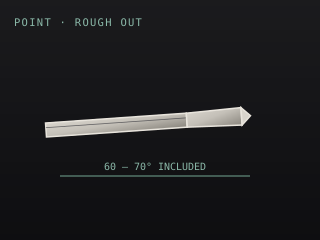
Concentrated impact for bulk removal — the roughing-out workhorse.
Specifications
| Point angle | 60 – 70° included |
|---|---|
| Tip radius | 1.5 – 2.5 mm (blunted deliberately) |
| Overall length | 200 – 260 mm |
| Shank | Octagonal, 12 – 14 mm |
| Head material | Hardened carbon steel, or carbide tipped |
| Handle | Unhandled, struck directly |
| Weight | 280 – 450 g |
Technical parameters
| Material | Hardened carbon steel (carbide for granite) |
|---|---|
| Stone suitability | Marble, limestone, granite, sandstone |
| Stage | Rough out |
| Strike with | Stone hammer, 1.5 – 2.5 lb |
| Edge life | Long — a blunt point wears slowly |
| Grind angle | Steeper than a flat chisel; a sharp point simply snaps |
ChiselsRough Out
Overview
A chisel ground to a blunt point, designed to deliver the full force of a blow into a very small area so the stone fractures and flakes away. It is the fastest way to reduce a block to a silhouette. It leaves a pitted, uneven surface by design — that is the next tool's problem, not the point chisel's.
Using it
- Work at roughly 30° to the surface, not perpendicular. Perpendicular blows dig pits instead of removing bulk.
- Drive the blow away from the finished form, never into a thin section you want to keep.
- Follow the grain on marble and limestone; fight it and you will split the block.
- Stop roughing at least 10 mm outside your intended surface. The point chisel is not a detail tool.
Safety notes
- The whole point of this tool is violent fracture. Stone chips travel fast and far — eye protection and a barrier are mandatory.
- Never point a chisel toward yourself or a bystander. Rebound happens.
- Inspect the head for cracks each session; a point chisel works harder than any other.
Works with
Marble blockGranite blockLimestone blockStone hammerMasons hammer
Educational reference only. Figures marked typical are conventional workshop ranges, not manufacturer specifications. This site sells nothing and endorses no brand. Working stone produces respirable crystalline silica — control the dust at the source, and check your local regulations, which may be stricter than the general practice described here.