Chisels & Carving
Tooth Chisel
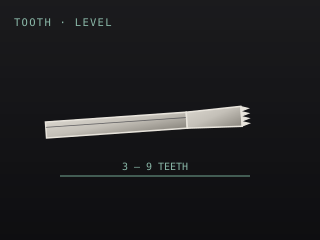
A row of teeth that levels the pitted surface left by roughing.
Specifications
| Teeth | 3, 5, 7, 9 in a row |
|---|---|
| Tooth pitch | 4 – 8 mm between tips |
| Overall length | 200 – 250 mm |
| Shank | Octagonal, 12 mm |
| Head material | Hardened carbon steel |
| Handle | Unhandled, struck directly |
| Weight | 240 – 400 g |
Technical parameters
| Material | Hardened carbon steel |
|---|---|
| Stone suitability | Marble, limestone, sandstone |
| Stage | Refine — between roughing out and planing |
| Strike with | Dummy hammer, 1.5 – 2 lb |
| Edge life | Moderate — teeth wear unevenly |
| Grind angle | Teeth cut on a 45° head, sharpened as a set |
ChiselsRefine
Overview
Several point-chisel tips cut into one head, so a single blow fractures a line of stone rather than a spot. It is the bridge between roughing out and refining: it removes the point chisel's pitting and begins to establish real planes, without the digging that a flat chisel does in a still-uneven surface.
Using it
- Run it in overlapping diagonal passes, then cross the diagonals. That is how you level a surface.
- Switch to a flat chisel once the pitting is gone. Continuing with the tooth chisel removes more than you want.
- Keep the teeth equal. One proud tooth scratches a line the flat chisel will struggle to remove.
- Work across the grain at a shallow angle for the flattest result.
Safety notes
- More contact points means more airborne chips. Eye protection and extraction at the cut.
- Teeth that have worn unevenly will skid. Re-cut the set rather than working around it.
- Do not use a tooth chisel on alabaster or soapstone — they will clog and tear rather than cut.
Works with
Marble blockLimestone blockSandstone blockDummy hammerFlat chisel
Educational reference only. Figures marked typical are conventional workshop ranges, not manufacturer specifications. This site sells nothing and endorses no brand. Working stone produces respirable crystalline silica — control the dust at the source, and check your local regulations, which may be stricter than the general practice described here.