Chisels & Carving
Flat Chisel
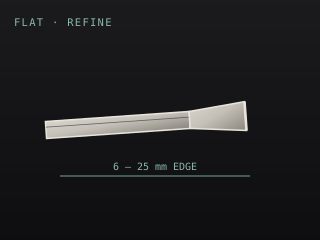
The general-purpose edge — planes, transitions and finishing cuts.
Specifications
| Edge width | 6, 10, 16, 20, 25 mm |
|---|---|
| Overall length | 200 – 250 mm |
| Shank | Octagonal, 10 – 12 mm |
| Bevel angle | 25 – 35° per side, softer stone takes the shallower |
| Head material | Hardened carbon steel, or carbide tipped |
| Handle | Unhandled — struck directly, never fitted with a wooden handle |
| Weight | 180 – 380 g depending on width |
Technical parameters
| Material | Hardened carbon steel (carbide for granite) |
|---|---|
| Stone suitability | Marble, limestone, alabaster, soapstone |
| Stage | Refine and finish |
| Strike with | Dummy hammer or mallet, not a steel hammer |
| Edge life | Re-sharpen every 20 – 40 minutes of marble work |
| Grind angle | Shallower for soft stone, steeper for hard |
ChiselsRefine Finish
Overview
A straight, flat-tipped chisel that removes stone in broad, controlled sweeps. It is the tool most sculptors reach for after roughing out, because it establishes flat planes and clean transitions faster than anything else. Edge width changes its character completely: a wide blade flattens, a narrow one reaches into a concavity.
Using it
- Hold the shank at about 45° to the surface and let the edge bite, rather than forcing it.
- Work a plane in overlapping passes. Trying to flatten in one cut digs a hollow.
- Re-sharpen the moment the edge reflects light along its length. A dull chisel bruises stone.
- Match edge width to the radius of the form you are cutting.
Safety notes
- Never strike a chisel with a steel hammer. The hardened head can shatter and throw fragments.
- Mushroomed heads must be ground off immediately — a burr will cut your palm.
- Wear eye protection. Chisel tips spall under a misaligned blow.
Works with
Educational reference only. Figures marked typical are conventional workshop ranges, not manufacturer specifications. This site sells nothing and endorses no brand. Working stone produces respirable crystalline silica — control the dust at the source, and check your local regulations, which may be stricter than the general practice described here.