Chisels & Carving
Gouge
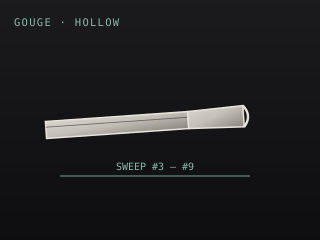
A curved cutting edge for hollows, folds and concave form.
Specifications
| Sweep | #3 (shallow) to #9 (near semi-circular) |
|---|---|
| Width | 6 – 25 mm |
| Overall length | 200 – 250 mm |
| Shank | Octagonal, 10 – 12 mm |
| Head material | Hardened carbon steel |
| Handle | Unhandled, struck directly |
| Weight | 200 – 380 g |
Technical parameters
| Material | Hardened carbon steel |
|---|---|
| Stone suitability | Marble, limestone, alabaster, soapstone |
| Stage | Refine |
| Strike with | Dummy hammer or mallet |
| Edge life | Moderate — the bevel is long and thins fast |
| Grind angle | Follows the sweep; never flatten the bevel |
ChiselsRefine
Overview
Ground with a U-shaped cross-section, a gouge cuts a concave channel rather than a flat plane. It is how you hollow a drapery fold, undercut a lip, or follow the inside of a curve without breaking the surface with a flat chisel. Sweep number controls how tight that curve is.
Using it
- Match the sweep to the radius you are cutting. A mismatched gouge fights the form.
- Cut downhill along the curve where the grain allows, so the edge exits the surface rather than diving.
- Rotate the gouge slightly as you drive it to keep the cut continuous.
- Use a shallow sweep for blending and a deep one for establishing hollows.
Safety notes
- A gouge under a heavy blow can skate sideways out of the cut. Keep your holding hand behind the cutting edge, never in front.
- Eye protection — a skipping gouge throws chips unpredictably.
- Do not use a mallet so heavy that you cannot control the sweep.
Works with
Educational reference only. Figures marked typical are conventional workshop ranges, not manufacturer specifications. This site sells nothing and endorses no brand. Working stone produces respirable crystalline silica — control the dust at the source, and check your local regulations, which may be stricter than the general practice described here.