Stone & Materials
Soapstone Block
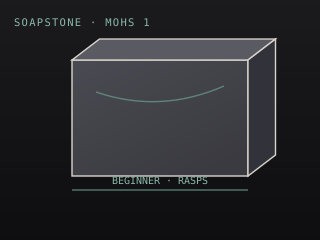
Soft talc schist — the stone most beginners should start with.
Specifications
| Typical block sizes | 10 × 10 × 20 cm to 30 × 30 × 50 cm |
|---|---|
| Density | 2.7 – 2.9 g/cm³ (≈ 2.8) |
| Mohs hardness | 1 (talc) — scratches with a fingernail |
| Grain | Schistose; a slight directional fabric |
| Porosity | Very low |
| Colour range | Grey, green, brown, near-black |
| Sound stone sounds | A dead, soft thud |
Technical parameters
| Material | Metamorphic talc schist |
|---|---|
| Working hardness | Mohs 1, carves with woodworking tools |
| Chisel type | Rasps, files, knives, and fine saws |
| Best for | First projects, maquettes, smooth organic form |
| Avoid | Crisp architectural detail; it will not hold an edge |
| Cost band | Low — the cheapest way to start carving |
StoneSelect Rough Out Refine Finish SealMOHS: 1DUST MEDIUMSTABLE
Overview
A metamorphic rock dominated by talc, soft enough to scratch with a fingernail and smooth enough to feel like soap. It is inexpensive, widely available, and shaped with woodworking tools rather than masonry ones, which makes it the standard recommendation for a first piece. The cost is that it abrades away quickly and holds no fine edge for long.
Using it
- Treat it like hardwood: rasps, files, scrapers, and a coarse saw to block out.
- Because it is so soft, mistakes accumulate quickly. Work in small increments.
- It polishes to a warm, almost waxy sheen with nothing more than a cloth and patience.
- The classic first project: a simple organic form, worked entirely by hand.
Safety notes
- Soapstone dust is fine, pervasive, and often contains tremolite or quartz. A P2/P95 mask is not optional.
- Talc dust is extremely slippery on a workshop floor. Extract at the tool and clean with wet methods.
- It abrades fast, so blades and rasps dull quietly. Check edges often.
Works with
Riffler fileSandpaperPolishing padWaxDust extraction
Educational reference only. Figures marked typical are conventional workshop ranges, not manufacturer specifications. This site sells nothing and endorses no brand. Working stone produces respirable crystalline silica — control the dust at the source, and check your local regulations, which may be stricter than the general practice described here.
Related stone
Marble Block
Dense, translucent calcite stone — the classic sculptural material.
StoneSelect · Rough Out · Refine · Finish · Seal
Granite Block
Hard, abrasive igneous stone that resists steel entirely.
StoneSelect · Rough Out · Refine · Finish
Limestone Block
Soft, forgiving sedimentary stone — the sensible first block.
StoneSelect · Rough Out · Refine · Finish · Seal