Hammers & Mallets
Stone Hammer
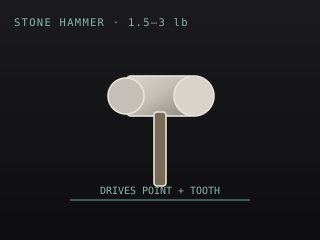
A heavy steel hammer that delivers the blow a point chisel needs.
Specifications
| Head weight | 1.5, 2, 2.5, 3 lb (0.7 – 1.4 kg) |
|---|---|
| Handle length | 250 – 300 mm |
| Face diameter | 28 – 34 mm, slightly convex |
| Head material | Forged carbon steel, tempered |
| Handle material | Ash or hickory, wedged |
| Balance | Head-heavy, for a driven blow |
| Best for | Roughing out with point and tooth chisels |
Technical parameters
| Material | Forged carbon steel head, hardwood handle |
|---|---|
| Stone suitability | Marble, granite, limestone, sandstone |
| Stage | Rough out |
| Pairs with | Point chisel, tooth chisel, bush hammer |
| Maintenance | Dress the face flat as it mushrooms |
| Never | Strike a chisel with a chipped or cracked face |
HammersRough Out
Overview
A steel-headed hammer with a face ground slightly convex and a head weighted for the sort of blow that removes bulk. It is the driver for point and tooth chisels during roughing out, where the goal is fracture rather than control. Face diameter matters more than weight: a small face concentrates force and shatters heads.
Using it
- Let the hammer fall rather than forcing it. Controlled weight beats muscle.
- Hold the chisel loosely so the blow transmits into the stone, not your wrist.
- Match head weight to stone hardness — heavier for granite, lighter for limestone.
- Dress the face with a file whenever it begins to mushroom.
Safety notes
- A steel hammer on a steel chisel is a hard, brittle interface. Inspect both for cracks and mushrooming before every session.
- Wear safety glasses. Fragments from a spalled chisel head travel further than stone chips.
- Check the handle for splits at the head. A hammer head that leaves the handle is a projectile.
Works with
Point chiselTooth chiselGranite blockMarble blockSafety glasses
Educational reference only. Figures marked typical are conventional workshop ranges, not manufacturer specifications. This site sells nothing and endorses no brand. Working stone produces respirable crystalline silica — control the dust at the source, and check your local regulations, which may be stricter than the general practice described here.