Hammers & Mallets
Bush Hammer
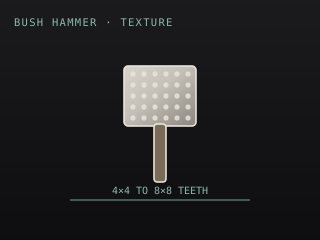
A grid of pyramidal teeth that texturises a flat surface evenly.
Specifications
| Head weight | 1.5, 2, 3 kg |
|---|---|
| Head size | 60 – 100 mm square |
| Tooth grid | 4 × 4 to 8 × 8 pyramidal points |
| Tooth height | 3 – 5 mm |
| Head material | Hardened steel, or carbide-tipped teeth |
| Handle length | 300 – 400 mm |
| Best for | Surface texturing, leveling, non-slip finishes |
Technical parameters
| Material | Hardened steel head with cut pyramidal teeth |
|---|---|
| Stone suitability | Granite, sandstone, limestone, hard marble |
| Stage | Finish — surface texture |
| Pairs with | Dust extraction, respirator, workbench |
| Maintenance | Re-cut the tooth grid when points round over |
| Never | Use on alabaster or soapstone — it will crush them |
HammersFinish
Overview
A heavy head covered in a grid of pyramidal points, used to level and texture a surface rather than to remove form. It leaves a uniform pitted finish that is both attractive in its own right and an excellent key for later work. Because the teeth are numerous, the blows spread across the face and the tool self-levels to a degree.
Using it
- Work in overlapping passes in one direction, then cross at 90°. That is what produces an even texture.
- Keep the head flat to the surface. Tilting digs a line of deep pits.
- Use it to level a surface before final finishing — it removes chisel marks efficiently.
- Re-cut the teeth as soon as the points round. Rounded teeth polish instead of texturing.
Safety notes
- A bush hammer produces a heavy, continuous dust plume. Extraction and a P100 respirator are required, not optional.
- It is heavy and swung repeatedly. Wrist and elbow strain is real — take breaks.
- Flying chips are coarse and fast. Full eye and face protection.
Works with
Educational reference only. Figures marked typical are conventional workshop ranges, not manufacturer specifications. This site sells nothing and endorses no brand. Working stone produces respirable crystalline silica — control the dust at the source, and check your local regulations, which may be stricter than the general practice described here.