Hammers & Mallets
Mason's Hammer
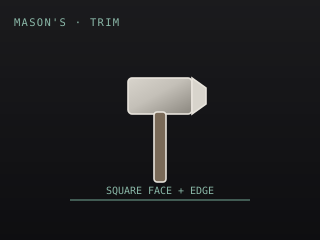
Square face one end, chisel edge the other — trimming in one tool.
Specifications
| Head weight | 1.5, 2, 2.5 lb (0.7 – 1.1 kg) |
|---|---|
| Handle length | 280 – 330 mm |
| Face | Square, flat, 25 – 30 mm |
| Cutting edge | Chisel edge across the head, 20 – 25 mm |
| Head material | Forged carbon steel, tempered |
| Handle material | Ash or hickory, wedged |
| Best for | Trimming blocks, knocking off corners, driving chisels |
Technical parameters
| Material | Forged carbon steel head, hardwood handle |
|---|---|
| Stone suitability | Limestone, sandstone, softer marble |
| Stage | Rough out and blocking |
| Pairs with | Point chisel, flat chisel, workbench |
| Maintenance | Re-grind the cutting edge square as it wears |
| Never | Use the cutting end on hard granite — the edge will chip |
HammersRough Out
Overview
A double-ended hammer: a flat square face for driving chisels, and a chisel-like cutting edge at the other end for trimming edges and knocking off arrises directly. It is a stone mason's tool rather than a sculptor's, but its edge end is genuinely useful for cutting a block down to size before carving begins.
Using it
- Use the square face for driving chisels and the edge for trimming, never the reverse.
- Trim from the corner inward, not the middle outward, to avoid splitting a slab.
- Take small bites along an edge. A full-depth edge cut invites a fracture.
- Keep the cutting edge dressed — a rounded edge bruises stone instead of cutting it.
Safety notes
- The cutting edge is a genuine blade. Keep hands and the holding hand well behind it.
- Eye protection without exception — this tool produces both stone chips and, if misused, steel fragments.
- Do not use the edge end on granite or any stone hard enough to chip the blade.
Works with
Educational reference only. Figures marked typical are conventional workshop ranges, not manufacturer specifications. This site sells nothing and endorses no brand. Working stone produces respirable crystalline silica — control the dust at the source, and check your local regulations, which may be stricter than the general practice described here.