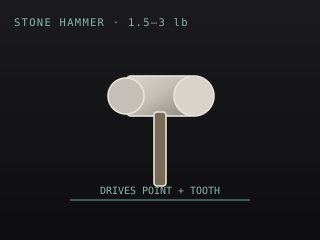
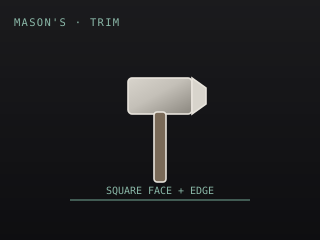
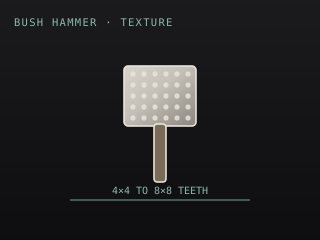
Hammers & Mallets
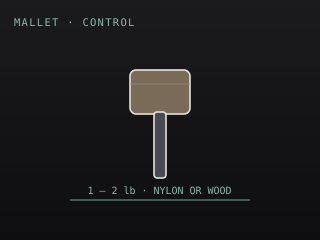
Mallet
Softer blows and better control when precision matters more than speed.
Specifications
| Head weight | 1, 1.5, 2 lb (0.45 – 0.9 kg) |
|---|---|
| Handle length | 250 – 300 mm |
| Head material | Beech, lignum vitae, or dense nylon |
| Face | Round or slightly domed |
| Handle material | Ash or hickory, wedged |
| Balance | Head-heavy with a shorter handle than a hammer |
| Best for | Refining, detail work, lettering, softer stone |
Technical parameters
| Material | Hardwood or dense nylon head, hardwood handle |
|---|---|
| Stone suitability | Marble, limestone, alabaster, soapstone |
| Stage | Refine and finish |
| Pairs with | Flat chisel, gouge, V-tool, lettering chisel |
| Maintenance | Replace a split head; do not glue and re-wedge |
| Never | Use on a point chisel for bulk removal — too slow |
HammersRefine Finish
Overview
A mallet gives up some of the hammer's force in exchange for control and a much gentler interface with the chisel. Wooden or dense-nylon heads absorb some of the blow, which is exactly what you want for refining, detail work and any cut where a fracture would be expensive.
Using it
- The classic guidance: a steel round dummy mallet of 1.5 – 2 lb and a dense nylon round mallet together cover almost every refining task.
- Let the head do the work. A mallet rewards rhythm over force.
- For lettering, use a light mallet and a loose grip — the chisel must be free to find its own line.
- Nylon mallets transfer more of the blow than wood, so step down in weight when switching.
Safety notes
- A mallet is far gentler than a steel hammer, but a split head can still fly. Inspect it.
- Eye protection is still required — the chisel is the hazard, not the mallet.
- Dense nylon mallets are excellent on chisels but will damage a wooden handle if used as a general hammer.
Works with
Educational reference only. Figures marked typical are conventional workshop ranges, not manufacturer specifications. This site sells nothing and endorses no brand. Working stone produces respirable crystalline silica — control the dust at the source, and check your local regulations, which may be stricter than the general practice described here.