Finishing & Polishing
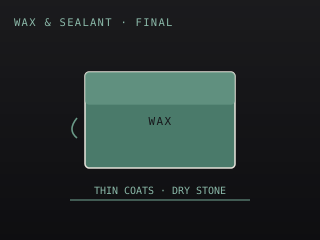
Wax & Sealant
A protective layer that slows staining without changing the surface.
Specifications
| Types | Penetrating sealant, hard wax, microcrystalline wax |
|---|---|
| Coverage | 8 – 15 m² per litre for sealant |
| Application | Brush or cloth, thin coats |
| Cure time | Sealant 24 h; wax 30 min between coats |
| Finish | Matte to satin; avoid film-forming gloss on stone |
| Re-application | Sealant every 2 – 5 years, wax as needed |
| Best for | Porous stone, exterior work, handled pieces |
Technical parameters
| Material | Solvent or water-based sealant; natural or synthetic wax |
|---|---|
| Stone suitability | Limestone, sandstone, alabaster, soapstone, marble |
| Stage | Seal — final step |
| Pairs with | Polishing pad, soft cloth, clean dry surface |
| Maintenance | Re-wax high-touch surfaces annually |
| Never | Seal a damp stone, or use a film-forming lacquer |
FinishingSeal
Overview
The last step, and the most often skipped. A penetrating sealant or a hard wax slows the rate at which a finished surface absorbs water, oils and dirt. On porous stones — limestone, sandstone, alabaster — it is the difference between a piece that ages and a piece that stains. On dense polished marble it is optional, and a poor choice of product can dull the polish you spent days achieving.
Using it
- The stone must be completely dry. Moisture trapped under a sealant will cloud.
- Apply thin coats. A heavy coat sits on the surface and looks like a plastic film.
- Buff off the excess before it sets. Excess wax is harder to remove later than to avoid now.
- Test on an offcut first. Sealants darken stone to varying degrees, and some darken a lot.
Safety notes
- Solvent-based sealants are flammable and produce fumes. Work ventilated, away from any ignition source.
- Wear gloves — sealants are skin sensitisers on repeated contact.
- Do not apply over a wet surface; trapped moisture causes clouding and efflorescence.
Works with
Limestone blockSandstone blockAlabaster blockSoapstone blockPolishing pad
Educational reference only. Figures marked typical are conventional workshop ranges, not manufacturer specifications. This site sells nothing and endorses no brand. Working stone produces respirable crystalline silica — control the dust at the source, and check your local regulations, which may be stricter than the general practice described here.