Stone & Materials
Alabaster Block
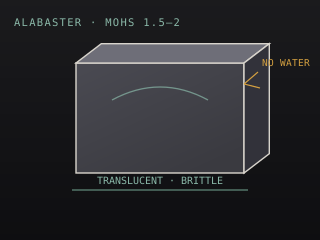
Translucent gypsum — carves like hard soap, breaks like glass.
Specifications
| Typical block sizes | 15 × 15 × 30 cm to 40 × 30 × 60 cm |
|---|---|
| Density | 2.2 – 2.4 g/cm³ (≈ 2.3) |
| Mohs hardness | 1.5 – 2 |
| Grain | Very fine, uniform; no visible bedding |
| Porosity | Low, but water-soluble |
| Colour range | White, cream, honey, veined brown |
| Sound stone sounds | A dull, soft tap |
Technical parameters
| Material | Gypsum — hydrated calcium sulphate |
|---|---|
| Working hardness | Mohs 1.5 – 2, carves with hand tools |
| Chisel type | Rifflers, rasps, and light steel only |
| Best for | Interior, backlit, translucent figure work |
| Avoid | Outdoors, wet rooms, or any damp environment |
| Cost band | Medium — sold by the piece, often by weight |
StoneSelect Rough Out Refine FinishMOHS: 1.8DUST LOWCRACK RISK
Overview
A fine-grained gypsum, chemically soft enough to shape with a kitchen knife and translucent enough to glow when lit from behind. That glow is why sculptors put up with it. It is also water-soluble, so a single night in a damp studio can ruin a finished piece, and its low toughness means fine unsupported detail snaps easily.
Using it
- Carve dry. Water is the enemy of both the finished surface and the tool life.
- Use rasps and rifflers for shaping rather than impact chisels.
- Because it is translucent, work the thickness deliberately where you want light to pass.
- Seal the finished piece to slow atmospheric moisture uptake.
Safety notes
- Gypsum dust is a respiratory irritant even though it carries little free silica. A P2/P95 mask is still the sensible default.
- Alabaster is water-soluble. Do not wet-carve it, and do not clean it with a damp cloth.
- It is brittle. Never clamp a finished piece in a vise — support it on foam.
Works with
Educational reference only. Figures marked typical are conventional workshop ranges, not manufacturer specifications. This site sells nothing and endorses no brand. Working stone produces respirable crystalline silica — control the dust at the source, and check your local regulations, which may be stricter than the general practice described here.
Related stone
Marble Block
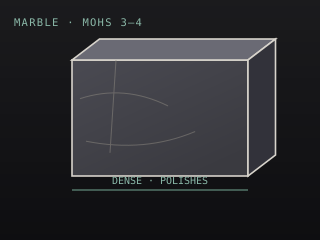
Dense, translucent calcite stone — the classic sculptural material.
StoneSelect · Rough Out · Refine · Finish · Seal
Granite Block
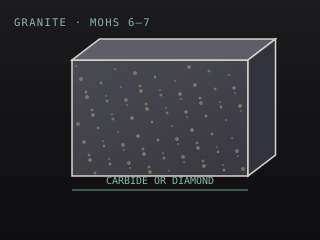
Hard, abrasive igneous stone that resists steel entirely.
StoneSelect · Rough Out · Refine · Finish
Limestone Block
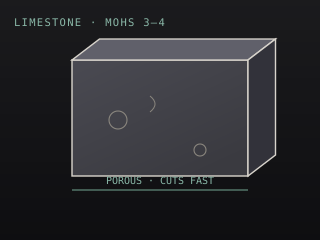
Soft, forgiving sedimentary stone — the sensible first block.
StoneSelect · Rough Out · Refine · Finish · Seal