Chisels & Carving
Lettering Chisel
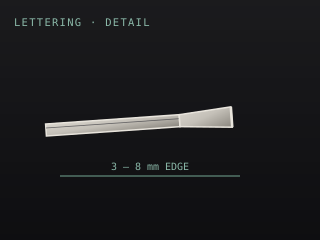
A narrow, rigid chisel for carved inscription and fine incised work.
Specifications
| Edge width | 3, 4, 6, 8 mm |
|---|---|
| Overall length | 180 – 220 mm |
| Shank | Tapered, 8 – 10 mm |
| Bevel angle | 20 – 25° per side (shallower for clean incisions) |
| Head material | Hardened carbon steel, finely tempered |
| Handle | Unhandled, struck with a light mallet |
| Weight | 120 – 220 g |
Technical parameters
| Material | Hardened and finely tempered carbon steel |
|---|---|
| Stone suitability | Limestone, marble, sandstone, slate |
| Stage | Finish — detail and inscription |
| Strike with | Light mallet, 1 – 1.5 lb |
| Edge life | Short — re-sharpen frequently during lettering |
| Grind angle | Shallow, and polished to a mirror |
ChiselsFinish
Overview
Essentially a very narrow flat chisel, often with a tapered and slightly reinforced shank, used to cut the strokes of carved letters. Lettering is the most demanding application in stone: a 4 mm stroke has nowhere to hide a mistake, and every cut is visible for the life of the monument.
Using it
- Draw the lettering at full size first, and cut only to the drawn line.
- Cut V-section strokes with two angled passes rather than one vertical one — the classic inscription profile.
- Sharpen far more often than feels reasonable. Lettering exposes every dullness.
- Work from the centre of a word outward so corrections can be absorbed at the ends.
Safety notes
- A lettering chisel is struck with a light mallet and held close. A slipped blow lands on your holding hand, not the stone.
- Eye protection at all times — small chips at close range.
- Do not use a steel hammer. The narrow head is the most likely to shatter.
Works with
Educational reference only. Figures marked typical are conventional workshop ranges, not manufacturer specifications. This site sells nothing and endorses no brand. Working stone produces respirable crystalline silica — control the dust at the source, and check your local regulations, which may be stricter than the general practice described here.