Hammers & Mallets
Pneumatic Hammer
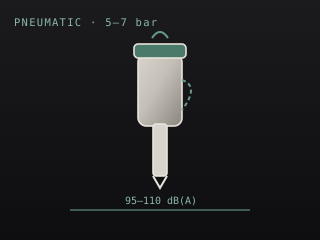
Air-driven impact that removes stone at many times the hand rate.
Specifications
| Air pressure | 5 – 7 bar (75 – 100 psi) |
|---|---|
| Blow rate | 1,800 – 3,000 blows per minute |
| Air consumption | 8 – 15 CFM at working pressure |
| Tool weight | 2.5 – 6 kg depending on class |
| Shank type | Hex or round, matched to the chisel |
| Noise level | 95 – 110 dB(A) at the operator |
| Best for | Bulk removal on large blocks |
Technical parameters
| Material | Hardened steel body, alloy piston |
|---|---|
| Stone suitability | Granite, marble, limestone, sandstone |
| Stage | Rough out — bulk removal only |
| Pairs with | Pneumatic chisels, compressor, extraction |
| Maintenance | Daily oiling, regular piston inspection |
| Never | Use for detail work or near a finished surface |
HammersRough Out
Overview
An air-powered hammer that drives a chisel at thousands of blows per minute. It turns a week of roughing out into an afternoon, and it turns a small mistake into a large one just as quickly. Noise, vibration and dust all scale up with the removal rate, which is why it sits at the far end of the workshop-safety spectrum.
Using it
- Stop at least 25 – 30 mm from your intended surface. The tool has no fine control.
- Let the tool cut at its own rate. Pressing harder stalls it and wears the piston.
- Work the mass, not the form. Everything within 30 mm of the surface is hand-tool work.
- Oil the tool every session, and check the chisel shank for wear — a worn shank will not hold.
Safety notes
- Hearing damage is the most common injury from pneumatic tools. 95 – 110 dB(A) requires hearing protection, always.
- Hand-arm vibration syndrome is cumulative and permanent. Limit continuous trigger time and take real breaks.
- A pneumatic chisel removes stone fast enough to sever a finger. Both hands on the tool, never on the work.
- Dust volume is far higher than hand work. Extraction and P100 filtration together.
Works with
Educational reference only. Figures marked typical are conventional workshop ranges, not manufacturer specifications. This site sells nothing and endorses no brand. Working stone produces respirable crystalline silica — control the dust at the source, and check your local regulations, which may be stricter than the general practice described here.