Chisels & Carving
V-Tool
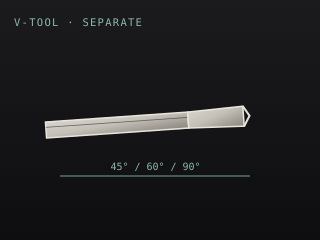
A sharp V for crisp lines, arrises and incised detail.
Specifications
| Angle | 45°, 60°, 90° included |
|---|---|
| Width | 6, 10, 16 mm |
| Overall length | 200 – 240 mm |
| Shank | Octagonal, 10 mm |
| Head material | Hardened carbon steel |
| Handle | Unhandled, struck directly |
| Weight | 180 – 300 g |
Technical parameters
| Material | Hardened carbon steel |
|---|---|
| Stone suitability | Marble, limestone, alabaster, soapstone |
| Stage | Refine and detail |
| Strike with | Mallet, light blows only |
| Edge life | Short — the apex is fragile |
| Grind angle | Inside faces flat; apex must stay sharp |
ChiselsRefine Finish
Overview
A chisel ground to a V-shaped profile that cuts a clean angular groove. It is the tool for separating forms — a line between a fold and a limb, an incised edge, the boundary of a carved motif. Where a gouge makes a soft hollow, a V-tool makes a decision.
Using it
- Score the line first with a light pass, then deepen. Trying to cut the full depth in one blow snaps the apex.
- Cut the groove before the surrounding surface is finished, so you can clean up any overrun.
- A 60° V-tool is the general-purpose choice; 45° for delicate work, 90° for broad separations.
- Keep a slip stone handy. This edge dulls faster than any other chisel.
Safety notes
- The apex of a V-tool is the most fragile edge in the workshop. Inspect it before every use — a chipped apex will scratch.
- Light blows only. A heavy strike buries the tool and breaks the point.
- Keep the holding hand clear; the V tends to walk along its own groove once it bites.
Works with
Educational reference only. Figures marked typical are conventional workshop ranges, not manufacturer specifications. This site sells nothing and endorses no brand. Working stone produces respirable crystalline silica — control the dust at the source, and check your local regulations, which may be stricter than the general practice described here.