Most people who want to carve stone spend their first month buying the wrong things. The craft is old and well documented, but the entry advice online is dominated by people who already own a full workshop and have forgotten what it was like to start from nothing. This guide is the version we wish someone had handed us: what to buy, in what order, and what to leave on the shelf.
What a first project actually requires
You need four things and nothing else: a soft stone, a way to remove bulk, a way to refine, and a way to protect your lungs. That is the whole list. Everything beyond that is optimisation, and optimisation is a second-year problem.
- One block of soapstone, roughly 20 × 15 × 15 cm. Inexpensive, carves with woodworking tools, and forgiving of hesitation.
- A coarse rasp and a half-round file. These do 80 % of the work on soft stone.
- A saw. Any coarse wood saw will block out soapstone, though a proper stone saw is nicer.
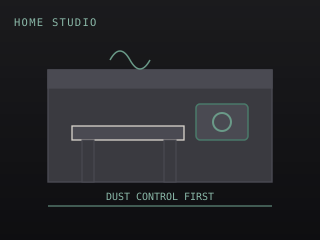
- A P2/P95 respirator and sealed goggles. Not negotiable, and not something to buy later.
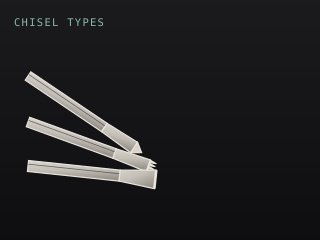
That is genuinely enough for a first piece. A hammer and a set of chisels are the natural next purchase, but they matter far more once you have worked a soft stone and understand how material behaves under an edge.
Choose the stone before the tools
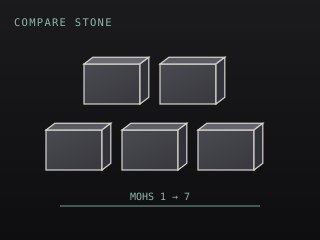
The single most common beginner mistake is buying tools for a stone they have not chosen yet. Stone hardness decides everything downstream: a chisel that is perfect for marble is useless on granite, and a set of fine files is wasted on a block of basalt.
For a first piece, stay at or below Mohs 3. Soapstone, alabaster and soft limestone are all workable by hand. Soapstone is the standard recommendation because it is cheap, available, and shaped by tools you may already own.
Block out, then refine — in that order
New carvers almost always start refining too early. They see a form in the block, make a careful cut, and then find they cannot reach the rest of the mass. Bulk removal comes first, and it comes off fast and without sentiment.
Draw the silhouette on all four faces
A form drawn on one face only will not be symmetrical, and you will discover that late. Mark the profile on every face of the block before you cut anything.
Remove everything outside the silhouette
Saw or rasp the block down to a rough approximation of the outline. Work quickly and without precision — you are reducing mass, not making the piece.
Establish the main planes
Once the mass is roughly right, flatten the major surfaces. This is where the piece starts to read as a form rather than a lump.
Refine the transitions
Now, and only now, work the joints between planes. This is where a piece stops looking carved and starts looking made.
Finish in sequence
Work through the grits. On soapstone, a coarse paper followed by a fine one and a cloth is often all that is needed.
The four mistakes that cost beginners the most
- Buying hard stone first. Marble is not a beginner material. It bruises, it fissures, and it punishes impatience.
- Skipping respiratory protection because the stone is soft. Soapstone dust is fine, pervasive, and often contains tremolite. Soft does not mean safe.
- Refining before the mass is correct. Hours of careful detail work on a form that is still 20 % too large.
- Sharpening nothing. Dull tools burnish stone instead of cutting it, which is how a surface develops a wave that no amount of sanding will remove.
What to expect from a first piece
Your first sculpture will be simpler than you imagined and it will take longer than you expected. That is normal and it is not a failure. The useful goal of a first piece is not to produce something beautiful; it is to learn how a particular stone responds to a particular tool, which is knowledge you cannot get from reading.
Pick something small, organic and non-figurative — a rounded form with no straight lines and no fine detail. It removes almost every way a first attempt can go wrong, and it lets you concentrate on the thing you are actually there to learn.
“Start with softer materials, and remember granite needs specialty tools.”
Where to go next
Once you have finished one soft-stone piece, the natural progression is limestone. It cuts with ordinary steel at a good rate, it does not bruise the way marble does, and it is cheap enough that a failed attempt costs very little. From there, marble becomes reasonable.