A stone studio is not a shed with a hammer in it. Stone carving produces more dust, more weight and more noise than almost any other craft, and a space that was not set up for those three things will be unpleasant at best and hazardous at worst.
The space itself
You need somewhere you can make a mess without caring, and where you can control the air. That rules out a shared room and makes a garage or outbuilding the realistic minimum.
- A hard floor you can wet-clean. Concrete is ideal; carpet is not viable at all.
- Room for a bench plus at least a metre of working space on every side of a block.
- A door that opens outward, or a window you can open fully, for ventilation.
- Power with RCD protection — you will be working wet.
- Somewhere to store stone that will not crack the floor. A 60 cm marble cube is about 580 kg.
The bench
The bench has one job above all: absorb energy without moving. A light bench rattles, bounces the blow back into the chisel, and walks across the floor. Build from thick timber — 50 to 100 mm top — with braced legs, and bolt it down if you work anything over about 40 kg.
Set the height so your forearm is horizontal when the chisel is at working height. Too low and you will hunch into a chronic back injury, which is the most common long-term complaint among sculptors and entirely preventable.
Dust control, which is the whole game
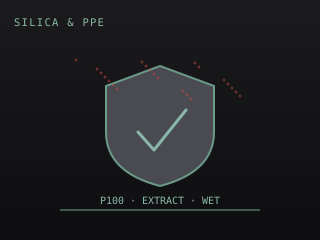
If you get one thing right in a home studio, make it dust control. Everything else is comfort; this is health, and the damage is permanent.
Decide your primary method
Wet where the stone allows. Water at the cutting point removes roughly 90 % of airborne dust and cools the tool.
Add extraction at the source
A HEPA H13 or M-class extractor with the hood as close to the cut as you can manage. Distance kills capture efficiency.
Fit a respirator
A P100 half-mask, fit-tested. Fit is everything — a leaking mask delivers almost nothing.
Set up wet cleaning
Wet cloths and a wet vacuum. Never dry-sweep. Dry-sweeping re-suspends settled dust and is a major exposure event.
Plan the emptying routine
Empty the extractor outdoors, wearing a mask. Doing it indoors releases a concentrated cloud.
“Use a mask and safety glasses. Consider wet carving — with water there is essentially no dust.”
Noise and vibration
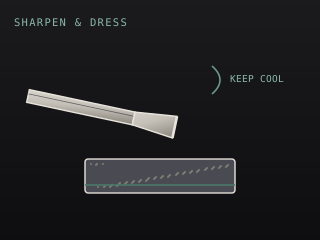
Hand tools are loud but tolerable. Pneumatic tools run at 95–110 dB(A), which requires hearing protection without exception, and produce hand-arm vibration that causes cumulative and permanent damage. If you use pneumatic tools, limit continuous trigger time, take real breaks, and keep the tools warm.
Consider the neighbours as well. Stone carving is a percussive noise that travels. Working hours matter, and a conversation with the neighbours before you start is cheaper than one after.
A realistic budget order
Buy in this order, and do not skip ahead. Each item on the list matters more than the one after it.
- Respirator (P100 half-mask) and sealed goggles — before anything else.
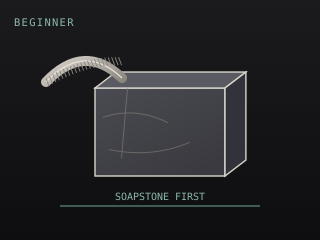
- Stone. A few blocks of soapstone and limestone to learn on.
- A coarse rasp, a half-round file and a saw.
- A bench you built, with a sandbag.
- A dummy mallet (1.5–2 lb) and a starter chisel set: point, tooth, flat.
- Dust extraction with HEPA filtration.
- A vise with soft jaws, a gouge and a V-tool.
- Abrasive papers through the grit sequence, and a polishing pad.
- A compressor and pneumatic tools, last, once everything else is right.
Notice that the compressor is last. It is the tool that everyone wants first and the one that is least useful until the dust control around it is already in place.